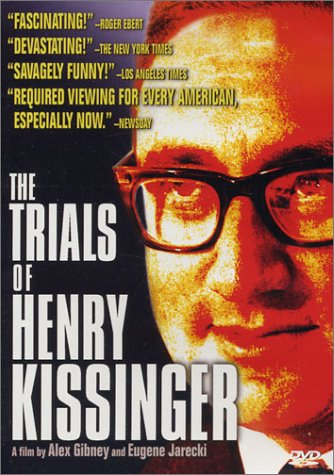
Title: The Trials of Henry Kissinger Genre: Documentary Director: Eugene Jarecki Cast: Brian Cox (Narrator) and others Runtime: 80 min
Narrated by actor Brian Cox, this documentary's position is unequivocal - that Dr Henry Kissinger, the former National Security Adviser and Secretary of State under Nixon and Ford, should be brought to trial at an international tribunal for war crimes. Kissinger is the quintessential realist who sees world politics as a power play between the superpowers, or dare I mention it, the balance of power that his admired Metternich and Bismarck shaped for old world Europe. Trials gives its viewers a rudimentary knowledge of Kissinger's beginnings and his ascendancy after his fortuitous escape from Nazi Germany. At its core Trials is an interesting documentary attempting to uncover a dossier of incriminating evidence against Kissinger - it is based on a book by Christopher Hitchens titled The Trial of Henry Kissinger. The entire movie is interlaced with interviews with former Administration officials and an unkempt Hitchens as he inveighs against Kissinger.
Of course the legacy of this celebrated diplomat is one of lustre. Still widely respected, with a series of bestselling memoirs and books, Kissinger is credited for his hardnosed realism that led to the detente with the-then Soviet Union and Communist China, capitalizing on the Sino-Russian split in the 1970s to further the American cause. Trials raises some startling accusations at Kissinger.
1. Kissinger would grab power at all costs. He sabotaged the peace talks between the US and North Vietnam during the end of Johnson's tenure so he could join the administration of the winner of the 1968 elections. He initially worked for Nelson Rockefeller, the Republican presidential candidate, but after Nixon got the Republican nomination, he jumped ship. This is not so much an accusation but a testament of the ruthless streak that Kissinger possessed in his thirst for power. However, the case against Kissinger hinges on whether the peace talks would have succeeded in ending the Vietnam war.
2. The expansion of hostilities through the bombing of Vietcong supply depots in Cambodia during the Vietnam war was the brainchild of Kissinger. The bombing raids killed 500,000 Cambodians, destroyed the country's agricultural sector, and precipitated the takeover of Cambodia by the Khmer Rouge in 1975. In William Shawcross' (author of Sideshow) words: the bombings created the conditions, in fact the only conditions suitable for the Khmer Rouge's rise in Cambodia.The Khmer Rouge went on to commit genocide on their own people, killing millions more Cambodians. The accusations here are twofold - First, the bombings on Cambodia were a declaration of war on Cambodia and required the approval of Congress. Nixon and Kissinger did not inform Congress, much less attain Congressional support for the euphemistically named "incursions". Second, the more tenuous accusation that the US, through its bombings, actually created conditions suitable for genocide under the Khmer Rouge.
3. Kissinger acquiesced in Indonesia's annexation of East Timor using American made arms. Kissinger did not want to lose an important ally in the Cold War and allowed American arms sales that were meant only for defensive purposes to be sold to Indonesia as they annexed East Timor, causing 100,000 civilian deaths.
4. When the Communist-supporting Allende won free elections in Chile, Kissinger wanted him removed from power. The CIA had planted spies into the Chilean military and there were elements within the military that supported a coup de tat. One General Schneider believed that the constitution bestowed upon Allende the power to rule the country in democratic elections. He was an obstacle to the coup. He was brutally assassinated by agents using American weapons shipped secretly from Washington. Soon after, Pinochet displaced Allende and became the head of state, setting of a 17 year cycle of terror and genocide in Chile.
The son of General Schneider actually commenced legal proceedings against Kissinger on September 11, 2001, but this was overshadowed by the terrorist attacks in New York.
Kissinger's brand of diplomacy is a throwback to a bygone era of clandestine meetings, secret diplomacy that would not be able to survive the relentless thirst for information and the need for accountability in a post-Vietnam, post-Watergate America. Rumours abound that Kissinger does not dare to travel to certain European capitals for fear of being arrested for crimes against humanity.
However, one must note the heightened sense of danger and suspicion the US as a whole felt during the Cold War. The proxy wars of Korea in 1950 and the nightmare of Vietnam controlled the collective American psyche and any means were used to justify the ends of checking Soviet expansionism, bridging the "missile gap", preventing the "dominoes from falling in South East Asia" across presidents and administrations. The Bay of Pigs fiasco under Kennedy, the countless attempts to assassinate Fidel Castro, the Iran-Contra crisis - the illegal acts committed by presidents and administrations blindsided by perceived superpower rivalry are numerous.
Second, the responsibility of America's hostile actions must ultimately rest with the president himself since he is the Commander-In-Chief. Kissinger obviously had tremendous control on the levers of power and had the confidence of the presidents he served under, but he is at best a powerful servant. Unless it can be proven that Kissinger took decisions unilaterally and allowed actions without presidential knowledge, responsibility for US actions should lie with the relevant president.
Thirdly, the convoluted issue of international law and universal jurisdiction is hardly resolved. The US has declined to join the International Criminal Court for fear that its troops might be hauled up to court for crimes against humanity when undertaking American missions. This lends credence to the opinion that weak states rely on international law as it is an equalizer of power, while strong states largely rely on power. The US would not want its power unhinged and checked by the rules of court. The US invasion of Iraq in 2003 is clearly illegal, but nothing can be done since the US is the world's sole superpower. Power, in the system of states, usually takes precedence over law. Kissinger himself, perhaps mindful of the ramifications on himself as the movie implies, is against universal jurisdiction. He maintains the the municipal law rules governing man in society cannot be applied to states as world leaders sometimes have to choose between "evil and evil". What constitutes illegality is defined by the victors. During WWII, the bombing of London was seen as a shocking war crime by Germany. But the absolute destruction of Dresden or the firebombing of Japanese cities did not constitute a war crime.
Trials raises more issues than it answers. Though Kissinger might have authorised illegal actions, America would not allow its former presidents or leaders to stand trial on foreign soil to face an international tribunal of war crimes. Pinochet and Milosevic were indicted for war crimes, but they were but leaders of Chile and Yugoslavia. No one would countenance putting ex-Americna presidents to trial. Powerful states can be less accountable in the chaotic international system. Muncipal law ensures a modicum of civility and order in society. In the anarchical society, the powerful and the winners write the script of History.
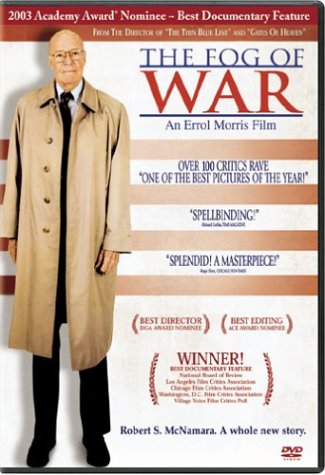
Title: The Fog of War Genre: Documentary Director: Errol Morris Cast: Robert S. McNamara Runtime: 107 min
This documentary by Errol Morris is a running interview with controversial former Secretary of Defense Robert S. McNamara who served under Kennedy and Johnson. McNamara is unobtrusively filmed expressing his views on events in hindsight namely the Cuban missile crisis, WWII, and the Vietnam War. The interviews are interspaced with disturbing archival footage from these events. Fog of War is on one level an anecdotal recollection of McNamara's life: from his earliest memories of the elated celebrations at the end of WWI, fondly recalling his precocious youth in grade school topping his class, to his meteoric rise to the helm of Ford Motor Company for five weeks until his almost impromptu induction into the administration at the behest of JFK. 85-year-old McNamara is candid in front of the camera, his eyes reddening as he recalls painful experiences. The clarity of his memory belying his age and his intelligence and the collages of infamous historical episodes make for riveting viewing.
Fog of War succinctly summarises the eleven lessons McNamara draws upon.
1. Empathize with your enemy. This is in relation to the Cuban missile crisis, in which McNamara does not revel in the triumphalism of having had a part in averting a world nuclear crisis, but proclaims that luck was on America's side as they stared down the barrel of nuclear war. He is full of praise for the rationality of the former ambassador at Moscow who advised a remedy without the application of force, in which Khrushchev could withdraw and save face by claiming he had saved Castro's Cuba from destruction by the US. Luck and empathy for the pressures faced by Khrushchev at the Politburo prevented the onset of total war.
2. Rationality will not save us. McNamara questions the relevance of rationality when the possibility of total destruction via nuclear warheads is in the hands of one leader. He suggests that only luck prevented the Cuban missile crisis from escalating into nuclear war, this in spite of rational men at the helm of government.
3. There's something beyond one's self.
4. Maximize efficiency. In WWII, McNamara was stationed in Guam as part of an elite intelligentsia tasked by the US Air Force to maximize the bombing effectiveness of the new B29 bombers. Instead of traversing back and forth from India to China to Japan for the bombing run, a base at Guam would save fuel and ensure the best efficiency.
5. Proportionality should be a guideline in war. McNamara's and his teams research led to the adoption of a new method of bombing of 67 Japanese cities, called firebombing, in which the high altitude B29s were to descend from their usual 23,000 feet to 5,000 feet, dropping incendiary bombs. 100,000 civilians were killed in Tokyo in one night in 1945. As an emotional McNamara reflects on this, he questions the appropriateness of force and concludes that there are no fixed guidelines for war. As his then-superior Colonel Curtis LeMay had said:
"If we'd lost the war, we'd all have been prosecuted as war criminals."
McNamara says:
"And I think he's right. He, and I'd say I, were behaving as war criminals.... But what makes it immoral if you lose and not immoral if you win?"
McNamara, still haunted by the sheer cruelty of the bombings, nevertheless grapples with the amoral nature of war as the victors are the ultimate arbiters of morality itself.
6. Get the data. The main reason for loss in bombing efficiency in WWII was the high rate of aborted missions which stood at 20%. McNamara's research concluded that most of the reasons for abortion were spurious and the aborted missions were the result of pilot cowardice. LeMay intervened, promising to sit in each mission as the pilots flew their sorties. The aborted mission rate plummeted. McNamara portrays the war-mongering LeMay well, recalling an incident in which a young captain had stormed into the command room after a mission, cursing those who had authorised high altitude B29s to fly at 5,000 feet, leading to the death of his wingman by gunfire. The usually monosyllabic cigar-smoking LeMay said that he feels the loss of that wingman he had sent on a mission, but the wingman is but one person, Tokyo has been razed to the ground.
One senses the grudging respect for LeMay amidst the adversarial clash of ideologies 17 years later in the Cuban missile crisis. There are similarities between LeMay and McNamara. LeMay, cold and bent on victory at all costs, was never averse to the use of force. Though reluctant and emotionally affected by civilian casualties, McNamara used the theory of "statistical control," a cost-benefit accounting procedure as stated in AJ Langguth's Our Vietnam, to calculate deaths during the Vietnam War. Whether McNamara believed in the pre-eminence of numbers and statistics and used this as an unemotional shield to the unpleasantness of civilian deaths, or whether he was the ever reluctant Cold-warrior staunchly defending LBJ during the Vietnam War is still unclear. He remains largely inscrutable as he struggles with reconciling the detached logic of numbers with the randomness of war.
7. Belief and seeing are both often wrong.
8. Be prepared to reexamine your reasoning.
9. In order to do good, you may have to engage in evil.
10. Never say never.
Often vilified as arrogant and termed Mac the "Knife" by the press during his much criticized stint as Secretary during the Vietnam War, McNamara makes an implict admission that the war was a wrong one. At Morris' prodding, he lets on that they [the Administration] saw what they wanted to believe in Vietnam. During LBJ's presidency, one false report by overzealous sonar men on board a US vessel of North Vietnamese torpedoes attacking them led to the gradual escalation into America's worst military debacle. The Cold War suspicions that the whole of Indochina and other smaller states would fall like dominoes to the scourge of Communism was the primary motivation for that war. McNamara says that the US did not understand its enemy the North Vietnamese.
He says:
"They believed that we [USA] had simply replaced the French as a colonial power, and we were seeking to subject South and North Vietnam to our colonial interests, which was absolutely absurd. And we, we saw Vietnam as an element of the Cold War. Not what they saw it as: a civil war."
One questions why McNamara never learnt his first lesson, to empathise with the Vietnamese before invading the country. However, there are many more reasons for the gradual escalation into war beyond his control, one of which is the misplaced fear of the spread of Communism and Superpower rivalry. McNamara leaves the administration in acrimonious fashion in 1967, unable to agree with a war that he so strongly opposed morally, yet supported publicly.
McNamara remains defensive about his role in the War, attributing ultimate responsibility for the conduct of war to the Commander-in-chief - the President, and adds almost with indignation that when he left in 1967, the casualty rate was 25,000 killed in action, less than half the eventual total of 58,000.
11. You can't change human nature. Definitely not a Wilsonian pacifist, McNamara believes that wars would go on as human nature is predisposed towards conflict. But he offers his views on US unilteralism vis-a-vis Vietnam as he says:
"I do not believe that we should ever apply that economic, political, and military power unilaterally. If we had followed that rule in Vietnam, we wouldn't have been there. None of our allies supported us. Not Japan, not Germany, not Britain or France. If we can't persuade nations with comparable values of the merit of our cause, we'd better reexamine our reasoning."
Though he refused to draw analogies with the ongoing war in Iraq, the comparisons are stark.
As the documentary draws to a close, McNamara startlingly says:
"Never answer the question that is asked of you. Answer the question that you wished had been asked of you."
This apparently undermines all he has said thus far, as it evokes images of McNamara, with his slicked back hair, facing the cameras during the Vietnam War, insisting beyond reason that according to General Westmoreland, good progress was being made in major operations.
However, this is hardly the slurred monologue of a bitter man, but an engaging testimony that pares McNamara down as it provides insight to the machinations of a complex mind - dispassionate and methodical yet sensitive and emotional. The luminous intellect of McNamara stands out as we view historical events through the eyes of a battled-hardened Cold-warrior, skilfully captured (almost) unadorned.